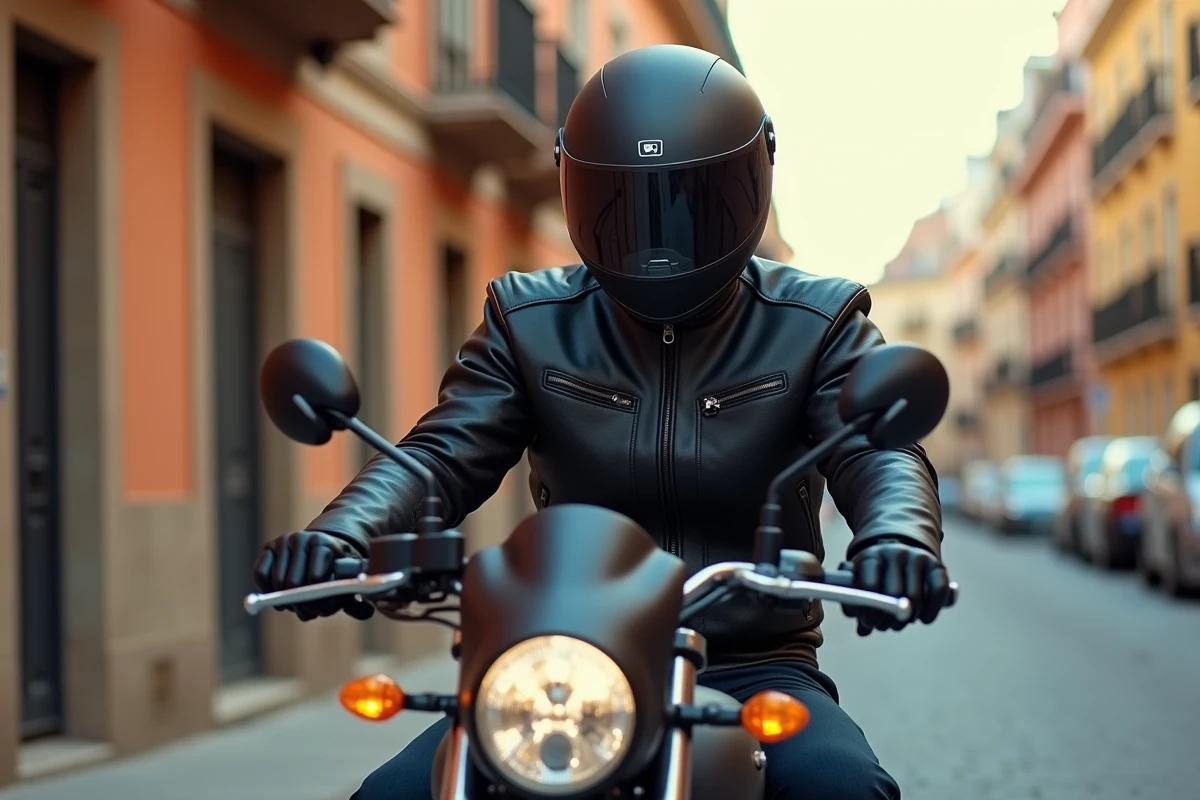
The Spanish B license allows access to 125cc motorcycles with a minimum of three years of experience, without any mandatory additional training. This particularity, often misunderstood by French drivers accustomed to 7 hours of post-license training, creates complex legal situations during extended stays or tourist rentals.
B License and 125cc in Spain: the Three-Year Experience Rule
The Spanish framework is based on a simple principle: any holder of a B license valid for at least three years can ride a 125cc motorcycle or scooter (category A1) on Spanish territory. No practical training, no driving school course, no additional exam.
This provision also applies to holders of a foreign B license, including French. A French driver on vacation in Barcelona or the Canary Islands can therefore rent a 125cc scooter with just their car license, provided they meet the experience requirement. We recommend keeping a record of information about the license proving the date of issue, as rental companies systematically check this point.
For more details on the regulatory conditions, a comprehensive file covers the 125 motorcycle license in Spain with administrative subtleties depending on the type of stay.
Structural Difference with France
In France, the 7-hour training (theory and practical) has been mandatory since 2011 for any holder of a B license wishing to ride a 125cc. In Spain, this requirement does not exist. The Spanish legislator considers that experience behind the wheel is sufficient as a prerequisite.
This disparity creates a trap upon return: a French person who has ridden a 125cc in Spain without the 7-hour training cannot replicate this practice on French soil. Fines in case of a check can reach 200 euros according to the DGT FAQ on foreign licenses.

Spanish A1 License: Enhanced Training Since January 2026
Spanish residents aged 16 and over who wish to ride a 125cc without waiting three years for a B license must take the dedicated A1 license. The process for obtaining it has been tightened by Real Decreto 1598/2025, which came into effect in January 2026.
The main change: an online theoretical training with a prior test in Spanish or Catalan is now mandatory before registering for the practical exams. This measure aims to reduce the failure rate in maneuverability and traffic exams.
A1 License Tests
The curriculum includes several distinct stages:
- Two theoretical exams, including the new online test introduced in 2026, covering regulations specific to two-wheelers and Spanish road signage
- A low-speed maneuverability test (slalom, U-turn, braking) on a closed course
- A fast circuit test to complete within a limited time, assessing trajectory control and acceleration
- A real-world traffic exam, in the presence of a DGT inspector
The total cost, including driving school, is around 1,500 euros according to feedback from Spanish motorcyclists. This training is not retroactive: A1 licenses issued before 2026 remain valid without additional requirements.
Non-Resident Candidates Excluded
Real Decreto 1598/2025 explicitly excludes non-residents from the online training program. A tourist or expatriate without tax residency in Spain cannot take the Spanish A1 license. They will have to rely on equivalence through their B license (three years of experience) or an A1 license obtained in their home country.
Speed Limit for 125cc on Spanish Highways: A Contested Ceiling
125cc motorcycles are allowed on certain sections of highways in Spain, but with a ceiling set at 90 km/h. This restriction is increasingly contested by Spanish motorcyclists, who find this limit unsuitable for the performance of current models.
Modern 125cc motorcycles reach top speeds well above this ceiling. Riding at 90 km/h on a lane where traffic flows at 120 km/h creates a speed differential that we observe as an increased risk factor during merges and overtaking.
The DGT has not announced a revision of this limit for 2026. Motorcyclists holding an A1 license or using the B equivalence are still subject to the same ceiling. Spanish speed cameras do not distinguish engine size: any exceeding of the speed limit for the vehicle category results in a penalty.
Insurance and Mandatory Equipment for Riding 125cc in Spain
The vehicle must have a valid civil liability insurance on Spanish territory. For rentals, this coverage is included in the contract. For a vehicle registered in France, the green card must mention Spain (letter “E”), which is the case by default for European contracts.
Regarding equipment, the Spanish regulatory framework requires:
- The wearing of an ECE-approved helmet for the rider and passenger, without exception, including in urban areas
- A reflective vest within immediate reach (mandatory in case of emergency stop on the road, not in traffic)
- Approved gloves, made mandatory by Spanish regulations for all motorized two-wheeler riders
The DGT report “Seguridad Vial 2025” published in March 2026 notes a significant increase in urban accidents involving 125cc, attributed to the lack of knowledge of local rules by temporary drivers. Tourists constitute an increasing share of accidents in urban areas.
Before renting a 125cc in Barcelona or elsewhere, checking the age of your license, bringing your green card, and your approved gloves remains the minimum to comply with. The apparent simplicity of the Spanish framework does not exempt one from rigorous preparation.