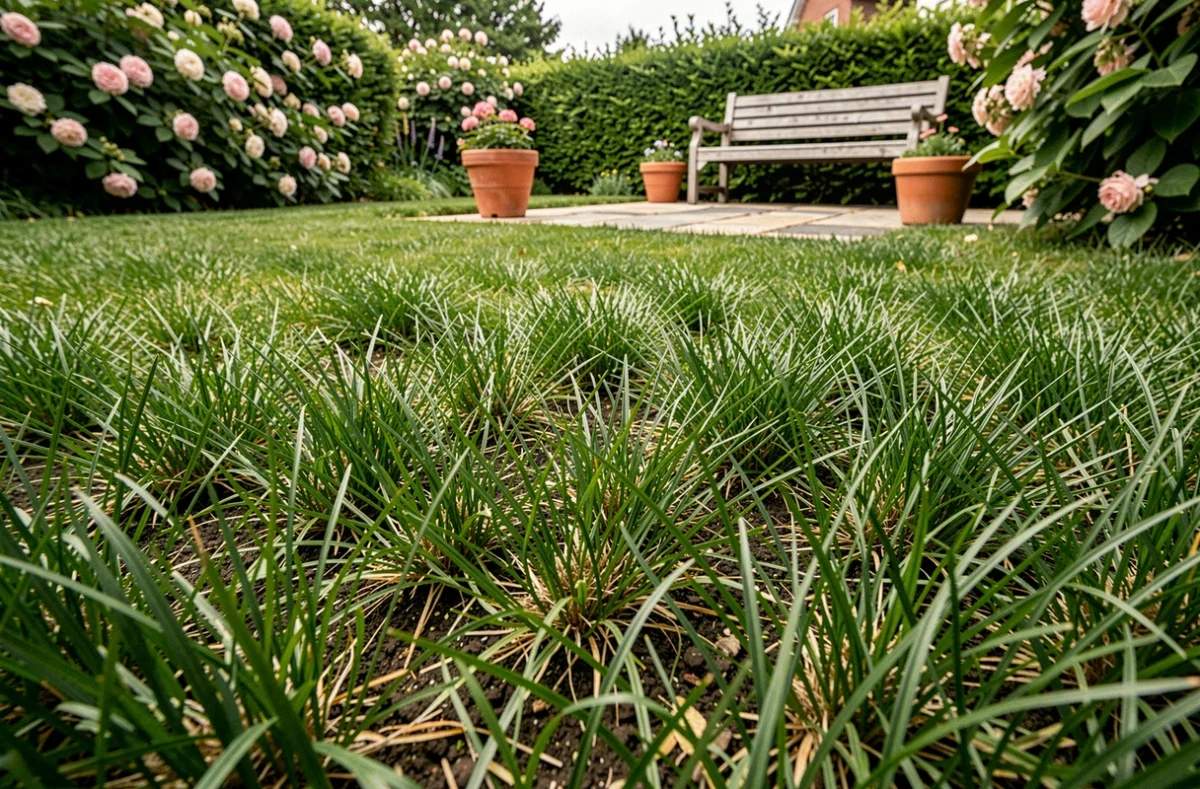
Classic lawns made of ryegrass or fescue show their limits as soon as temperatures consistently exceed 27 °C. Their metabolism, known as C3, slows down and then stops growth, causing the garden to yellow within a few weeks of a heatwave. Hybrid C4 grass offers an alternative based on a different photosynthetic mechanism, capable of maintaining plant activity at much higher temperatures. It remains to examine what this promise concretely implies in terms of installation, maintenance, and limitations.
C4 Metabolism and Hybridization: What Physiology Changes Daily
A C4 grass produces four carbon atoms during photosynthesis, compared to three for a C3 grass. This additional carbon, stored in the leaves, allows the plant to continue photosynthesis even when the stomata close due to high heat. The suitable growth window is between 25 and 38 °C, where a C3 grass stops growing.
Hybridization adds a layer of complexity. Some hybrids incorporate synthetic fibers into the substrate to enhance mechanical resistance, while others cross C4 varieties to improve a specific trait.
The hybrid bermudagrass Coachella, developed by the University of California, Riverside, illustrates this second approach: it combines increased drought tolerance with a shorter winter dormancy. For a private garden, this means a lawn that greens up earlier in spring and better withstands long summers.
Understanding the benefits of hybrid C4 grass requires going beyond the sole argument of heat resistance: it is the complete vegetative cycle, from spring awakening to autumn dormancy, that changes in timing.

Hybrid C4 Grass in Temperate Climates: Results and Gray Areas
The central question for a gardener located north of the Loire is winter persistence. Pure C4 varieties (cynodon, zoysia, kikuyu) enter dormancy as soon as nighttime temperatures drop below 10 °C. The grass yellows and only resumes growth with the return of heat. In the Mediterranean zone or the southwest, this dormancy remains short. The further north you go, the longer it extends.
Field reports vary on this point. Some users report a decent maintenance of green on south-facing areas protected from frost, while shaded areas remain brown until May. New hybrid varieties like Coachella attempt to reduce this period, but the available data does not guarantee identical results in Brittany and Montpellier.
Criteria to Check Before Sowing in Temperate Zones
- The average minimum temperature in January in your municipality: below -5 °C for extended periods, most C4 grasses suffer long-term
- The exposure of the land: a garden facing south recovers faster than a garden set back or shaded by buildings
- The nature of the soil: C4 grasses prefer well-drained soils, and a compact clay substrate can limit their deep rooting
Maintenance of Hybrid C4 Grass: Needs Shifted, Not Eliminated
The common belief that hybrid C4 grass requires almost nothing deserves to be nuanced. Maintenance needs do not disappear; they change in schedule and nature. Mowing remains necessary, sometimes more frequent in summer as growth accelerates precisely when a C3 grass is dormant.
Fertilization follows a different logic. A C4 needs concentrated nitrogen inputs during the warm period (May to September), while a C3 is primarily fertilized in spring and autumn. If the substrate is very well-drained, as is often the case with hybrid installations with synthetic fibers, fertilization must be earlier and more regular to compensate for the rapid leaching of nutrients.
Soil aeration poses a specific problem for hybrids containing synthetic fibers. Classic coring operations can tear these fibers and degrade the structure. Tools need to be adapted or interventions spaced out, which increases the risk of organic mat formation on the surface.
Watering: Real Savings or Myth
A C4 grass consumes significantly less water than a C3 in the height of summer. Its stomatal closure mechanism limits transpiration. In practice, this allows for reduced watering frequency, sometimes by half depending on local conditions. The savings are real, but it does not mean zero watering: during prolonged heatwaves without rain, some watering is still necessary to avoid forced dormancy.
Regulation and Microplastics: An Often Ignored Angle for Gardens
The European regulation 2023/2055 on synthetic polymer particles targets, among other things, the granules used in artificial and hybrid surfaces. For sports fields, this issue is already well documented. For a private garden, it is much less so.
A hybrid grass incorporating synthetic fibers into the substrate potentially generates microplastics through mechanical wear (foot traffic, mowing, weather). The European regulation places these sources among those to be monitored, making the choice of a system that limits free granules and plans for their confinement relevant.
If your priority is to avoid any synthetic component, purely plant hybrids (crosses between C4 varieties) are an alternative. Their mechanical resistance is lower than that of fiber hybrids, but for an ornamental garden without intensive sports use, the difference remains acceptable.
- Synthetic fiber hybrid: high mechanical resistance, microplastic vigilance, adapted maintenance to preserve fibers
- Pure plant hybrid (crossing of C4 varieties): no plastic components, standard mechanical resistance, classic maintenance of C4 grass
- Pure non-hybrid C4 grass (cynodon, zoysia): maximum simplicity, but longer winter dormancy and lower tolerance to foot traffic
The choice of hybrid C4 grass for a garden depends on a trade-off between climate tolerance, type of maintenance accepted, and sensitivity to synthetic materials. No variety ticks all the boxes simultaneously. The best approach remains to cross the characteristics of your soil, your climatic zone, and the actual use of your lawn before ordering seeds.