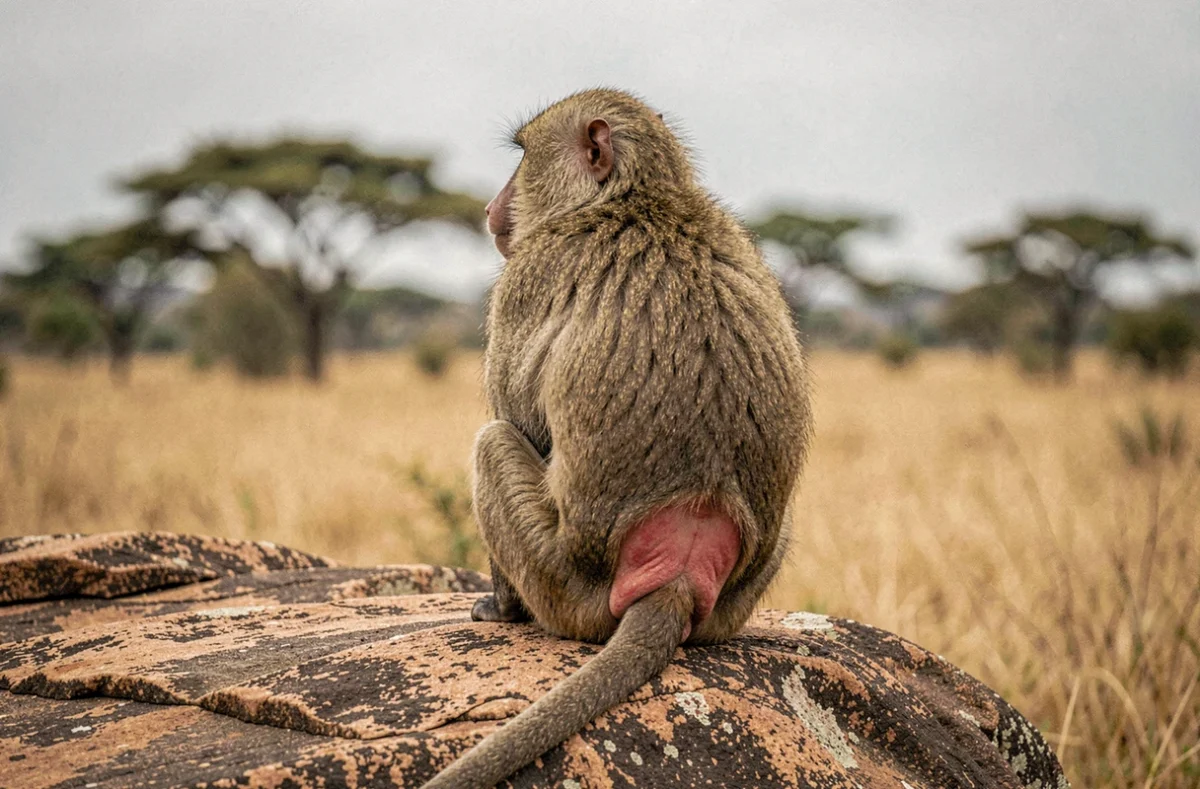
Perineal swelling in female baboons is not simply a fixed anatomical feature. The size, color, and swelling of this area fluctuate throughout the reproductive cycle, providing males in the group with visual cues about the female’s sexual receptivity.
This signal varies among species in the genus Papio and cannot, on its own, reveal an individual’s exact reproductive status. Referring to a baboon with a red rump is really a way of describing a sexual communication mechanism shared by several species, not a distinct taxonomic category.
Baboon perineal swelling: a graded reproductive signal
Perineal coloration functions as an honest signal of fertility in females. The skin around the anogenital region gradually swells during the follicular phase of the cycle, reaches peak swelling around ovulation, and then subsides. Its color shifts from pale pink to bright red, sometimes purplish, depending on local blood flow.
This mechanism is not unique to a single species. It is observed in the chacma baboon (Papio ursinus), the olive baboon (Papio anubis), and the Guinea baboon (Papio papio), with varying intensity and duration. The hamadryas baboon (Papio hamadryas), by contrast, displays much less pronounced swelling.
Males interpret this signal alongside other cues, including posture, behavior, and pheromones. Reducing the red-rumped baboon to a visual curiosity means overlooking the complexity of the communication system that underpins reproduction in these primates.
Baboon dietary flexibility in the face of ecological disruption
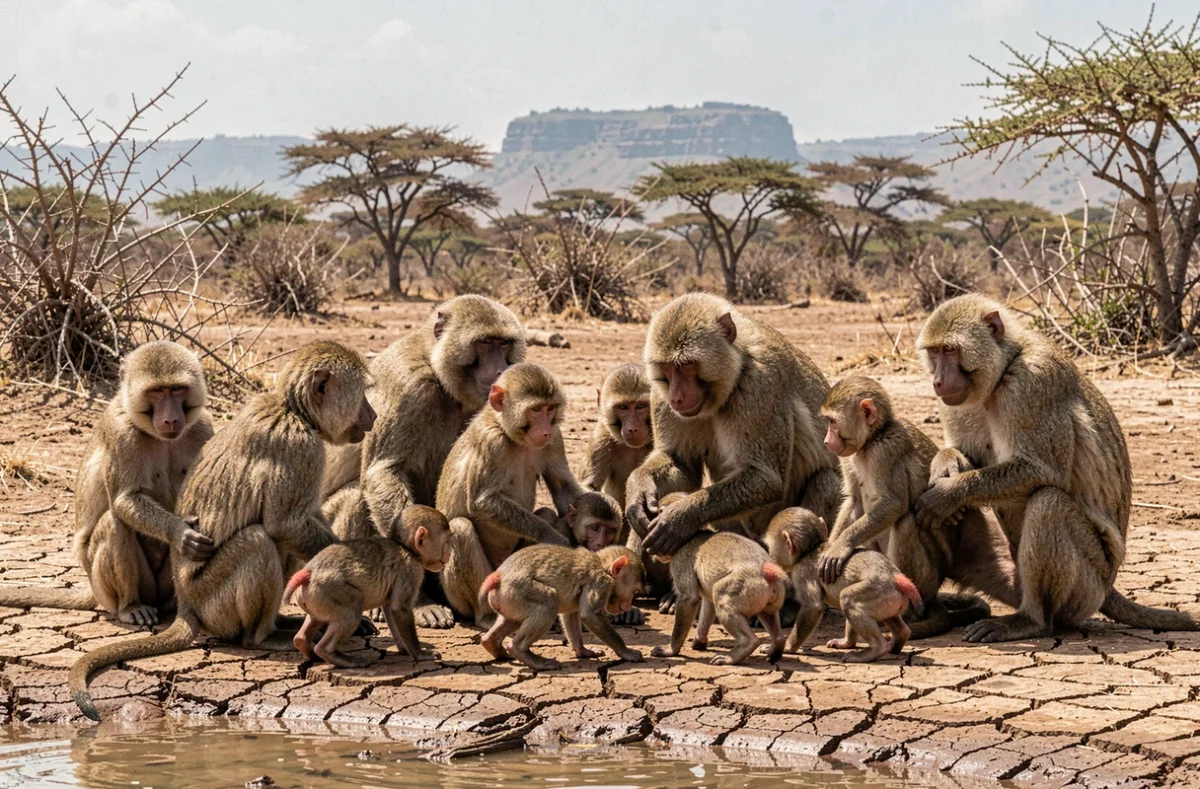
Baboons are opportunistic feeders, but their adaptability goes beyond a simple omnivorous diet. A study of Guinea baboons documented a revealing case: after a fire destroyed much of the ripe fruit on a plant the group relied on, the animals changed how they used their habitat and altered their daily routes.
Rather than staying in the depleted area, the group expanded its home range and made use of alternative resources. When the fruit returned after the plants regrew, the baboons resumed their usual routes. This behavior demonstrates a strong spatial memory combined with active assessment of resource availability.
This behavioral flexibility helps explain why the genus Papio occupies such a wide range of habitats, from dry savannas and gallery forests to semi-desert areas. We find that general-interest content about baboons rarely mentions this cognitive flexibility, focusing instead on lists of the foods they eat.
Baboons in urban areas: more than a waste problem
Coexistence between baboons and human populations, particularly on the Cape Peninsula in South Africa, is often reduced to a story about poorly secured trash cans. The reality is more complex.
Baboons continue to enter urban areas even when waste is inaccessible. Gardens, ornamental plants, water sources, and shaded shelters are enough to keep residential areas attractive. Securing garbage containers is a useful measure, but it is not enough to prevent incursions.
The factors that attract chacma baboons to urban areas fall into several categories:
- Direct food sources: garden fruit, vegetable patches, unharvested fruit trees, and accessible leftovers in public spaces
- Indirect resources: standing water, lawn irrigation, and shaded areas that provide shelter from the heat
- Landscape structure: green corridors connecting natural habitat to residential neighborhoods, and a lack of continuous physical barriers
The animal welfare debate in Cape Town
In Cape Town, a proposal to relocate and confine two baboon troops prompted public objections. Critics raised concerns about the potential effects of confinement on the group’s social relationships, restrictions on freedom of movement, and the chronic stress associated with captivity.
This debate illustrates a fundamental point: managing urban baboons is not solely a matter of public safety or property protection. It involves ethical trade-offs in how we treat social, cognitively complex animals whose group structures depend on hierarchical and affiliative bonds built over many years.
Relocating a troop is not the same as moving a group of isolated individuals. The disruption of social bonds can cause stress comparable to that caused by losing access to food resources.
Baboon classification and species: clarifying the taxonomy
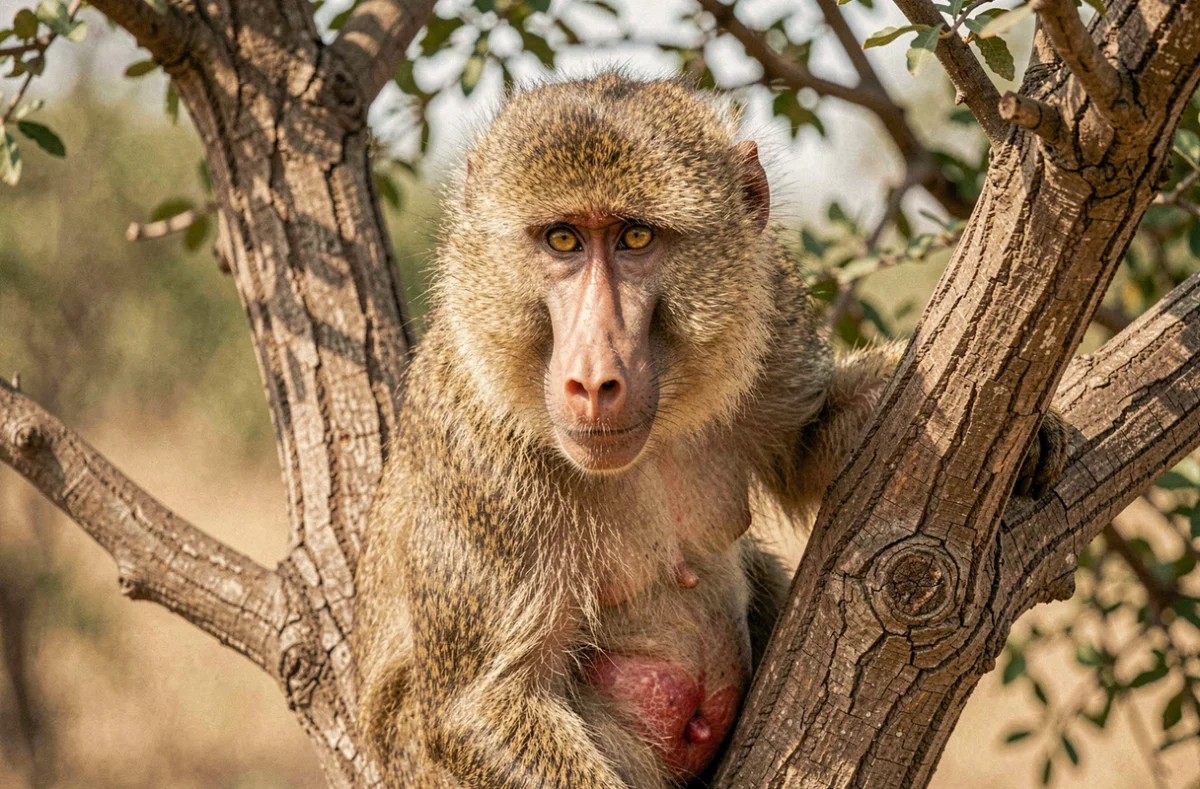
The term “red-rumped baboon” does not correspond to any species recognized in current classifications. The genus Papio includes several species, all of which may display varying degrees of perineal coloration:
- Papio hamadryas (hamadryas baboon), found mainly in the Horn of Africa and the Arabian Peninsula
- Papio anubis (olive baboon), distributed across a broad swath from West Africa to East Africa
- Papio cynocephalus (yellow baboon), found in East and southern Africa
- Papio ursinus (chacma baboon), the southernmost species, found in southern Africa
- Papio papio (Guinea baboon), restricted to West Africa
Natural hybridization between species in contact zones further complicates classification. Olive and hamadryas baboons can produce fertile offspring in areas of overlap in Ethiopia.
Attributing perineal coloration to a single species is therefore a misleading simplification. This trait crosses the genus’s taxonomic boundaries, and its expression depends on hormonal, individual, and species-specific factors. We recommend always specifying the species in question rather than using ambiguous common names.
Baboon social life, dietary flexibility, and the tensions associated with their presence in urban areas form a set of issues that goes far beyond the anatomical curiosity of red rumps. Each species in the genus Papio has behavioral adaptations specific to its environment, and conservation challenges vary considerably from one region to another.