
Children’s self-confidence is part of the psychosocial skills defined by the French Public Health Agency: cognitive, emotional and social skills acquired in different areas of life.
Treating it as a simple personality trait that can be encouraged with compliments means overlooking the mechanisms at play. Supporting a child’s confidence day to day requires understanding what undermines it, coordinating the adults around them and providing practical tools suited to their age.
School pressure, screens and instability: factors that erode children’s confidence
A report published by the HCSP in September 2025 identifies several factors associated with declining mental health among young people: school pressure, social comparison amplified by digital media, family instability and socioeconomic inequalities. These factors act simultaneously, and their combined effect is more than any one parent can offset alone.
Digital comparison deserves particular attention. An eight- or nine-year-old exposed to content showing other children’s achievements (academic, athletic or creative) internalizes a gap between how they see themselves and what they believe to be the norm. This mechanism cannot be addressed simply by limiting screen time: the selection bias the child is seeing needs to be explained explicitly, using language suited to their development.
Family instability (separation, moving house, financial insecurity) has a different effect. It undermines the basic sense of security on which confidence is built. The Île-de-France Regional Health Agency reminds us that mental health also depends on the family environment, socioeconomic conditions and access to resources. Blaming parents alone for a child’s lack of confidence is a flawed analysis.
Among Happy Licorne’s advice for children are approaches that take this broader environment into account rather than focusing solely on isolated exercises.
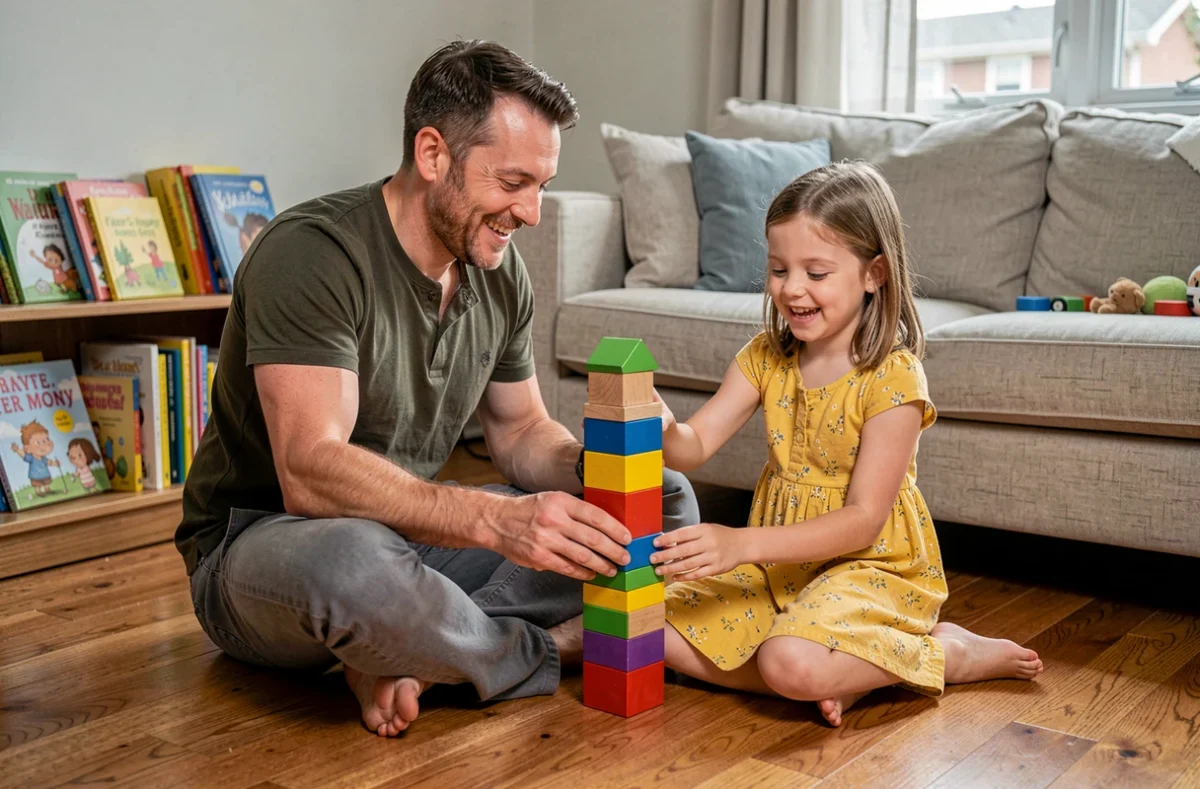
Coordinating the adults around a child: the psychosocial skills approach
France’s national strategy for developing psychosocial skills, launched for the 2022–2037 period, sets out a clear framework: coordinated action across several areas of a child’s life is more effective than isolated initiatives. Schools, childcare settings, health services and community organizations all have a role to play.
In practice, this means that building confidence does not depend solely on what happens at home. We find that children make faster progress in regulating their emotions when their teachers, after-school activity leaders and parents use consistent emotional vocabulary.
Which adults can support parents
- Teachers can directly strengthen a child’s sense of competence by recognizing the learning process rather than focusing on grades, particularly in the setting where school pressure is greatest.
- A doctor or school nurse can spot signs of withdrawal, anxiety or low self-esteem that a child may not always express at home.
- Sports or arts instructors provide a space where children can fail without academic consequences, helping to reduce their fear of making mistakes.
- A school or private-practice psychologist can step in when a lack of confidence persists and interferes with daily life (school refusal, social isolation).
Coordinating these adults does not require a formal meeting. A communication notebook focused on achievements and emotional difficulties, shared between home and school, is enough to create continuity.
Everyday activities to build confidence at different ages
Useful activities differ for a three-year-old and a ten-year-old. A child’s cognitive and emotional development determines what they can take in.
Under six: building independence through everyday tasks
At this age, confidence comes from physical mastery and the ability to do things independently. Letting a four-year-old pour their own water, choose their clothes or put away their toys in an organized space within their reach has a measurable effect on their sense of competence. Independence is built through repeated small decisions, not speeches.
A parent’s role is to resist the urge to correct or hurry things along. A child who puts their shoes on the wrong feet and notices it themselves learns more than one who is corrected before they have finished.
Ages six to ten: naming emotions and learning from mistakes
During the school years, social comparison becomes more active. Children measure themselves against their peers. Building confidence at this stage involves two key approaches:
- Name emotions precisely. “You’re frustrated because you didn’t get it right the first time” is more helpful than “It’s okay.” The first response validates the emotion; the second dismisses it.
- View mistakes as information. When a math problem goes wrong, asking “What got in your way?” directs the child’s attention to the process. This develops emotional regulation in the face of failure, a psychosocial skill identified by the French Public Health Agency.
- Choose cooperative rather than competitive games. Board games where everyone wins together remove the fear of losing and strengthen a sense of belonging.
Children’s confidence and living conditions: don’t treat a collective problem as an individual one
Too many articles about children’s confidence present it as a matter of parenting style. If a child grows up in overcrowded housing, attends a school where classes have more than 30 pupils and has no access to extracurricular activities, advice about using positive language will make little difference.
Confidence develops in an environment that makes it possible. The 2022–2037 national strategy takes this into account by also targeting community organizations and local policies. Local authorities, neighborhood associations and social services all contribute to the network of support for families.
Supporting a child as they build confidence means taking action on two levels: the everyday relationship (conversation, listening, shared activities) and the environment in which they grow up. Parents who identify the support available around them—whether it’s an attentive teacher, an accessible sports club or a healthcare professional—give their child more of the support they need to grow.