
Since schooling became mandatory from the age of three, the issue of rest time in kindergarten resurfaces every school year. The regulatory framework requires the child’s presence during the hours set by the school, including in the afternoon. However, no text from the Ministry of Education mandates that a child in the first year of kindergarten must actually sleep during nap time.
The school must provide a designated rest time, not guarantee sleep. This distinction, often misunderstood, opens up a space for dialogue between families and teaching teams.
Attendance Requirement and Rest Time in First Year of Kindergarten: What the Regulatory Framework Says
The kindergarten teaching program (BOEN special n°2 of March 26, 2015) explicitly includes rest times as part of the educational activities. Reception, recess, nap, and hygiene are organized by responsible adults to provide reassuring markers for young children.
The back-to-school circular for 2024, commented on by several DASEN and IA-IPR, reminds us that the obligation pertains to presence during school hours, not to sleeping. A child enrolled in the first year of kindergarten must be present in the afternoon. Parents who consistently pick up their child before the end of the day without a legitimate reason risk being reported for absenteeism to the academic inspection.
To delve into the practical modalities governing mandatory naptime in the first year of kindergarten in 2026, it is necessary to distinguish between two levels: the obligation of schooling (non-negotiable) and the organization of rest (adaptable).
Parents’ Flexibility to Adapt Naptime Without Risking a Report
The gap between the rule and daily practice is wide. Several levers exist for families who find that collective naptime no longer suits their child.
Negotiate an Arrangement with the Teaching Team
The synthesis from the National Education Scientific Council (CSEN, March 2022) emphasizes that a nap offered to a child who no longer needs it is often associated with disturbances in nighttime sleep. Conversely, a child who still needs to sleep is not penalized in their nighttime sleep by school naptime.
This scientific finding provides a concrete argument for parents. During the back-to-school meeting or at any time during the year, they can request a meeting with the teacher to discuss adapting the rest time. The goal is not to eliminate afternoon presence but to negotiate the conditions: the child stays in the dormitory without the obligation to sleep or joins a quiet workshop after a period of observation.
Occasional Early Dismissal and Individualized Welcome Project
Some schools accept, upon written and justified request, an occasional early dismissal. This flexibility depends on the school’s internal regulations and the position of the principal. No national rule precisely governs this situation.
For children with documented sleep disorders, a medical certificate can support the request. The individualized welcome project (PAI), usually used for allergies or chronic conditions, provides a formal framework if the school doctor validates the need for a specific arrangement. Field feedback varies on this point: some academies accept a PAI related to sleep, while others reserve it for strict medical situations.
- Request a meeting with the teacher as soon as the nighttime sleep issue arises, bringing a record of bedtime and wake-up times over two weeks.
- Formulate the request in writing to the principal, citing the CSEN synthesis on the effects of a nap imposed on a child who no longer needs it.
- If a PAI is considered, first consult the treating physician to obtain a certificate describing the sleep disorder, then seek validation from the school doctor.
The limit not to be crossed remains repeated unexcused absences in the afternoon. A child removed from school every day at noon without the principal’s agreement generates a record of absences.
Organization of Naptime in Class: What Varies from One School to Another
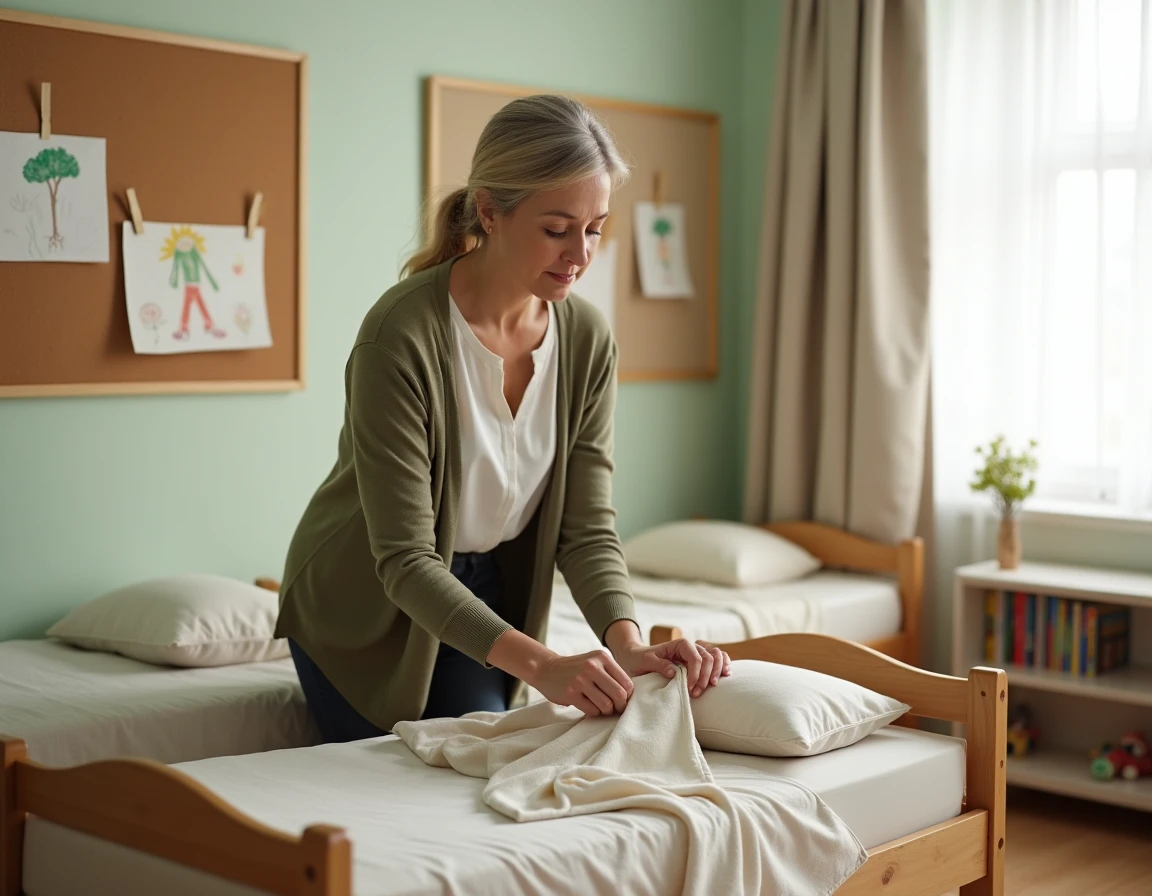
The BOEN of 2015 establishes a principle of flexibility. The organization of naptime should be able to accommodate the necessary flexibility to meet the needs of each child, which evolve between the ages of two and six. Naptime cannot be imposed on a child who does not need it, and conversely, it cannot be denied to one who does.
In reality, human resources condition this flexibility. The presence of an ATSEM during rest time allows awake children to participate in an activity with the teacher. Without an available ATSEM, the entire group remains in the dormitory, including those who are not sleeping.
Practices also vary according to the size of the school. In a single-class structure, the teacher manages the small, medium, and large sections alone. Naptime then mainly concerns the younger children, while the older ones continue their learning. In a school with multiple classes in the first year of kindergarten, a rotation may be implemented: children who no longer sleep join a group for quiet activities after the first half hour.
Changes During the School Year
Most teachers in the first year of kindergarten gradually reduce the duration of naptime between January and June. The need for daytime sleep decreases significantly over the course of the year for the majority of three-year-olds. A child who slept for an hour and a half in September may not fall asleep at all by April.
Parents who wish for an adjustment should therefore make their request after the winter holidays, a time when teachers often reassess the organization of the dormitory. A request in September, when the child is discovering school, will almost always be denied.
What the Regulations Do Not Decide Regarding Naptime in Kindergarten
Several gray areas persist. No national text sets a maximum or minimum duration for rest time. No age threshold automatically triggers the end of naptime. The decision rests with the teaching team, in conjunction with families and the school doctor if necessary.
- The school’s internal regulations may provide specific provisions regarding naptime, but they cannot contradict the principle of flexibility established by the BOEN.
- A systematic refusal of arrangements, without examining the individual situation of the child, can be contested with the district’s national education inspector (IEN).
- Parents do not need to provide a medical certificate to request a simple adjustment of rest time. The certificate only becomes useful if a PAI is considered.
The boundary between the obligation of presence and the adaptation of rest remains a matter of local dialogue. The text protects both the child’s right to rest and the parents’ right to reasonable accommodations. When this dialogue fails, recourse to the IEN remains the formal path, before any escalation to the academic mediator.