
A garden that makes you want to stay does not rely on an accumulation of plants and furniture. It results from a balance between the available soil, the actual exposure of the land, and the maintenance capacity over several seasons. Transforming a garden into a dream space first requires understanding what the land allows, then choosing designs that withstand time and climatic constraints.
Water stress and a minimalist garden: designing a sustainable space from the start
Watering restrictions multiply every summer in many French municipalities. Designing a garden without incorporating this factor exposes you to burnt flowerbeds as early as July or fines in case of a prefectural decree.
The concept of a dry garden does not refer to a barren or dreary space. It encompasses a design principle where selected plants tolerate prolonged periods without water. Lavenders, shrubby sages, ornamental grasses, euphorbias, or gaura create generous scenes without requiring regular watering once well-rooted.
Mineral (gravel, pumice) or organic (wood chips) mulching limits evaporation and protects the soil. Combined with a selection of Mediterranean or drought-tolerant plants, it significantly reduces the time spent watering. To find concrete ideas for suitable plantings and layouts, the garden on Les Bricoleries de Nanie offers paths to explore based on each land’s configuration.
Thinking sustainably from the design stage also avoids disappointments: English lawns require a considerable amount of water and weekly maintenance, whereas a low flowering meadow or a persistent ground cover offers a comparable visual result with a fraction of the effort.
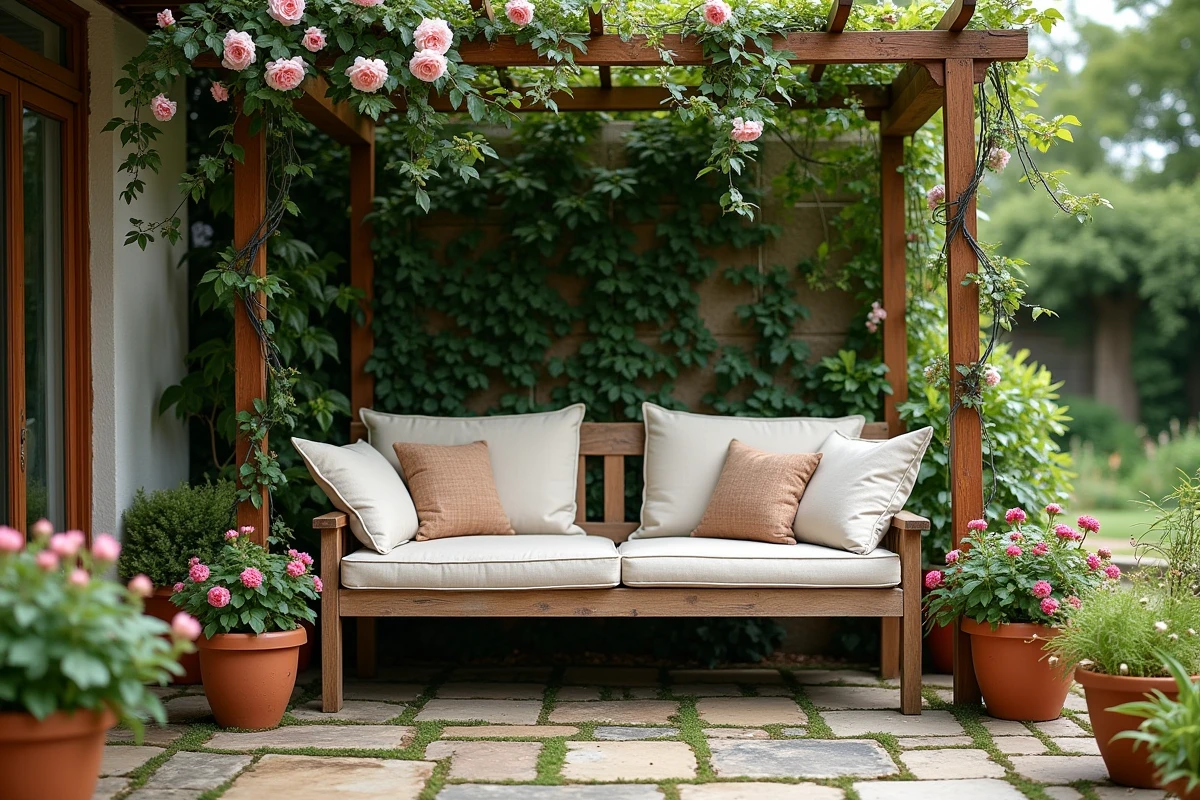
Garden layout according to the area: small urban plot or large space
Effective solutions for a city courtyard do not work in a suburban garden, and vice versa. Ignoring the surface constraint is the primary source of failures in outdoor landscaping.
Small gardens and narrow courtyards
In a limited area, every square meter serves multiple functions. A storage bench doubles as seating. A green wall (trellis, climbing plants on taut cables) compensates for the lack of depth with verticality.
- Raised planters or elevated beds allow for growing herbs and small shrubs without in-ground soil
- A light-colored surface (limestone slabs, white gravel) visually enlarges the space and reflects light in shaded courtyards
- Outdoor mirrors fixed to a fence wall create a surprising illusion of depth in enclosed spaces
Large gardens: structuring to avoid maintenance burdens
A vast area without structure quickly becomes a maintenance chore. Creating distinct zones connected by pathways provides clarity to the garden: a dining area close to the house, an ornamental bed in the middle of the plot, a wilder garden at the back.
Free hedges (a mix of shrubs with staggered flowering) advantageously replace single-species hedges of thuja. They require only one annual pruning and offer visual interest for several months.
Real maintenance after transformation: what inspirations do not show
Photos of transformed gardens capture a specific moment, often a few weeks after planting. The reality over two or three years differs significantly.
Untreated wood turns gray in less than two seasons. Pine or larch terraces change color quickly if they do not receive a saturator each year. Composite wood is more expensive to purchase but ages without notable maintenance.
On the plant side, ornamental grasses gain volume and must be cut back every late winter. Ground-cover perennials like creeping thyme or sedum eventually colonize pathways if not contained. Anticipating this dynamic avoids tedious uprooting.

The weekly maintenance time directly depends on the initial choices:
- A traditional lawn requires mowing every ten days in season, plus scarifying and reseeding annually
- A mulched dry garden requires light weeding and pruning of shrubs once or twice a year
- A raised vegetable garden involves near-daily monitoring during peak summer production
Choosing your level of involvement before planting anything remains the most structuring decision for a garden that ages well.
Outdoor lighting and nighttime ambiance: extending garden use
A garden that only exists during the day loses half its potential, especially during summer months when evenings stretch. Outdoor lighting is not limited to a string of lights hung between two trees.
Low-voltage solar lights line a pathway without buried wiring. Their autonomy has improved in recent years, and LED models offer a warm white that avoids the clinical effect of older garden lights.
To highlight a tree or a stone wall, a recessed adjustable spotlight creates a striking upward effect. Lighting grazing along a low wall or border is enough to outline the garden’s contours without dazzling.
The basic rule: light the volumes and textures, not the flat surfaces. A bed lit from below takes on a relief it lacks in full daylight. A pathway that is too brightly lit resembles a parking lot.
The cost of solar lighting remains modest, and installation requires no electrical intervention. However, low-voltage spots connected to the domestic network require a buried technical conduit, to be planned before laying the final floor covering.
A carefully transformed garden maintains its quality over time, provided that the materials, plants, and level of maintenance were calibrated from the start. The final result depends less on the budget than on the coherence between the land, the local climate, and the actual time available for care.